A misreading of history. . .
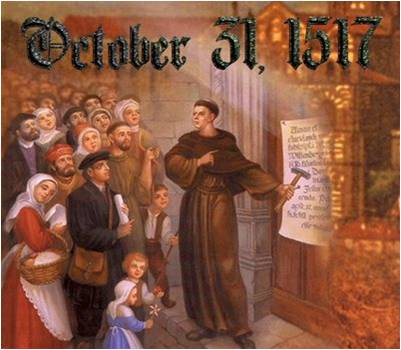
It was a time of question and concern. What was the right and true authority for the Christian? Was it deposited in earthly men and earthly institutions or was it retained by God in the primacy of His Word as source and norm of all doctrine? Authority seems a quaint concern in our modern era in which little is granted much authority and skepticism is the norm. But Luther was no skeptic. He was not the humanist of Erasmus but a child of his time, surveying the corrupt landscape of Christianity and seeking to know that God was still present amid immoral popes, bishops, and priests, and dogmas which had no authority beyond the realms of the church which perpetuated those dogmas. He was a man with a personal stake in this crisis but he was not driven by his own experience nor was he satisfied by that experience. It was an external and objective truth He sought and it was the spark of the Reformation fire that this truth was found objective and concrete in the living words of the Word of God that endures forever. Luther could be accused of being naive and idealistic but it would be a very hard stretch to say that Luther was an experiential Christian. He certainly had little idea of the realities of the world beyond his own little world of Wittenberg nor any appreciation for the complexities of the then modern political life -- nor did he much care. There was a higher calling and a higher purpose at work in Luther and that was the Kingdom of God and how it comes. Luther was painfully transparent, moody, and filled with angst and a most unlikely candidate to have fostered the Great Reformation movement. Erasmus was surely the better choice for the role -- if anyone were casting it. But it was Luther who drove home the point over and over again and for which Lutherans still wrestle -- my conscience is captive to the Word of God. Luther was loathe to change much more in that church tradition that must be changed and then only those traditions with recent pedigree and those which promoted an anti-Scriptural accretion of works righteousness into a gracious construction of hope in Christ alone. And so we struggle with the man and the movement even today. Consider the rash of books good and bad published for the movement's 500th anniversary year. Consider the blame of some who place all modern day woes of Christianity upon the doorstep of Martin and Katie. Consider the abandonment of Lutherans of their Luther and, even more significantly, of their own Symbols. No, Luther was not an experientialist who judged tradition according to his own measure of things but a rather unlikely choice for God to use to raise Scripture up at a time when reason, works, and morality had all but buried the prize born of suffering and the life that rose from the ashes of death. Happy Reformation!


Comments
Post a Comment